Authored by: Dr.Sofia Hawelia (orthodontist)
You’ve decided your smile needs a refresh. Maybe your front teeth are chipped, stained, or just not the shape you want. Now you’re looking at your options, and two names keep coming up: porcelain veneers and dental crowns.
The confusion is totally understandable. Both are cosmetic solutions that sit on your teeth. Both look natural. But here’s the thing—they’re actually quite different in how they work and what they can fix. Let me walk you through the real differences so you can make a choice that actually fits your needs.
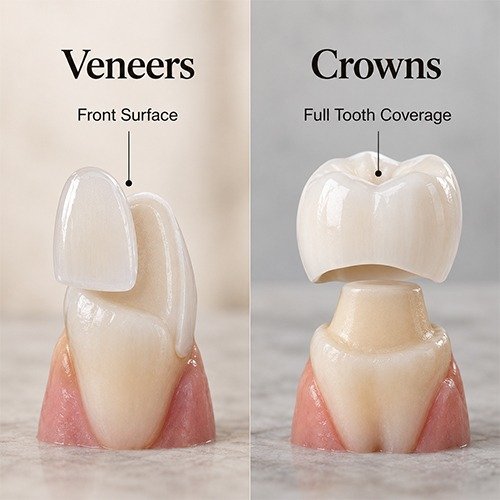
Think of veneers as a thin cosmetic shell that covers just the front surface of your tooth. They’re wafer-thin—about as thick as a contact lens—and they’re bonded directly to the front of your tooth using dental cement.
Here’s what happens in the process:
Veneers are perfect if you like your tooth’s basic shape and size but want to change the colour, close small gaps, or fix minor chips. They don’t require the tooth to be filed down as much as a crown does, so you’re preserving more of your natural tooth structure.
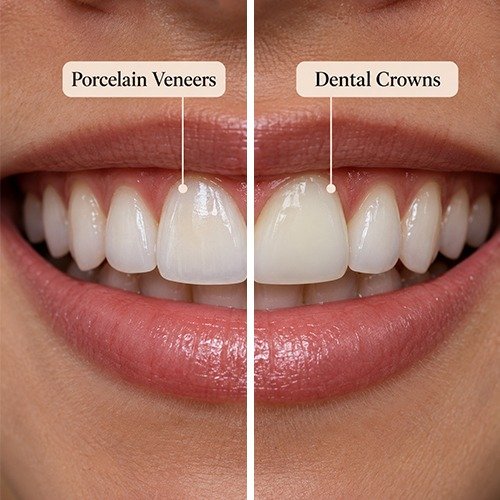
A crown is more like a full cap that covers your entire tooth, right down to the gum line. Instead of just covering the front surface, a crown wraps all the way around.
Here’s how a crown typically gets placed:
Crowns handle bigger problems. They’re the solution when a tooth is badly damaged, has a large filling, has had a root canal, or is severely discoloured. They also provide strength and protection—which is why they’re often necessary after a root canal when the tooth is fragile.
You’re a good candidate for veneers if:
You’re a good candidate for crowns if:
When patients ask me about porcelain veneers vs dental crowns, there’s usually one practical question underneath: “What do I actually need?”
Here’s my honest answer: if your tooth is healthy and the problem is purely cosmetic, veneers are the smarter choice. You’re keeping more of your natural tooth, and that matters long-term. But if there’s structural damage, decay, or the tooth has been compromised—especially by root canal therapy—a crown is the right tool for the job.
I’ve seen patients try to force veneers onto teeth that really needed crowns, and it doesn’t end well. The veneer can’t provide the strength or protection that a tooth needs. Conversely, I’ve recommended crowns to patients with healthy teeth, and they realise afterwards that veneers would’ve been the better first step.
The key is having an honest conversation with your dentist about what’s actually going on with the tooth, not just what you want it to look like.
Both veneers and crowns are durable, but they need care:
Crowns can sometimes last 15+ years. Veneers typically last 10-15 years and might need replacement sooner if you have habits that put stress on them. Neither is permanent, and eventually, you might need maintenance or replacement.
Only if your tooth doesn't actually need a crown. If the tooth is weak, has significant decay, or has had a root canal, a crown is the right choice even if it costs more. Skipping that step usually leads to bigger problems.
Both can look completely natural when done well. It depends on the skill of your dentist and the lab that makes them. The best cosmetic dentistry is invisible.
It's possible but difficult because the veneer is bonded to your tooth. If you want to switch to a crown later, your dentist can remove it, but there will be some additional tooth removal involved.
You might have some sensitivity after placement, but it usually subsides within a few days. If pain persists, let your dentist know.
With crowns, wait until the anaesthetic wears off (about 2-3 hours). With veneers, the same applies. Avoid hard or sticky foods for the first 24 hours with either option.